
FirstEnergy Employees Combat Lanternflies While Powering Pollinators
Every autumn, the skies along Lake Erie’s shoreline come alive with fluttering wings as monarch butterflies make their epic migration south. It’s a breathtaking natural spectacle. This year, behind the beauty lies a surprising twist: the very plant that nourishes these butterflies might also be a secret weapon against one of Northeast Ohio’s most persistent pests.
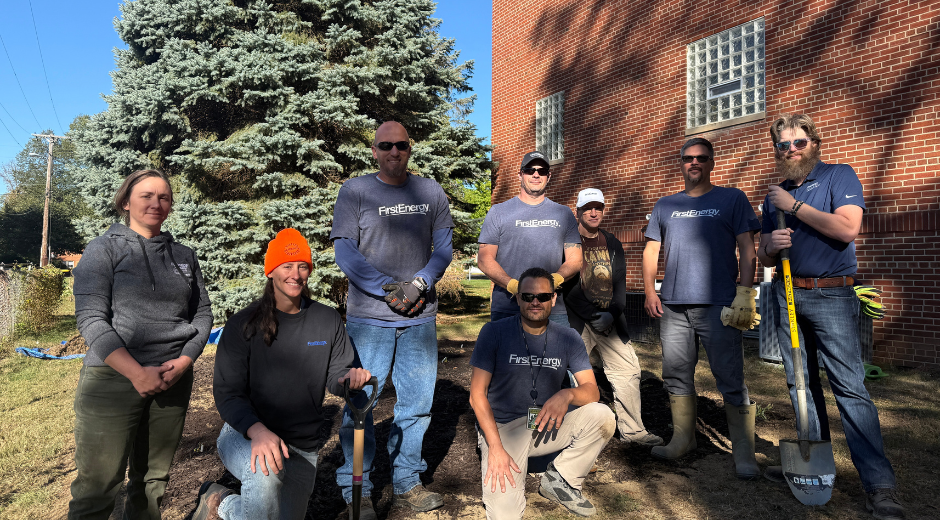
FirstEnergy employees recently rolled up their sleeves to plant a type of milkweed in a new pollinator garden at Washington Avenue Church in Elyria. While milkweed is well-known as a lifeline for monarchs, researchers recently discovered it’s also toxic to spotted lanternflies (SLF), an invasive species wreaking havoc on local agriculture and ecosystems. Studies showed that common milkweed can kill 60–80% of SLF nymphs and adults within just 24 hours. It’s a promising breakthrough that’s now being explored further by scientists at Penn State University.
“It’s amazing to think that something as simple as planting native flowers may be able to create such a big impact down the road,” said Kevin Mariner, a FirstEnergy lines supervisor who helped plant the garden. “We’re not just beautifying a space, we’re helping protect our environment.”
Watch a video to see the pollinator garden volunteers planted at Washington Avenue Church.
Growing Biodiversity, One Garden at a Time
FirstEnergy-planted pollinator gardens are filled with native wildflowers and grasses and they provide essential food and shelter for bees, butterflies, birds and other pollinators whose populations are in decline due to habitat loss.
What began as a pilot program to enhance biodiversity along transmission lines has blossomed into a companywide commitment to environmental stewardship. Over the past five years, FirstEnergy has planted and restored more than 280 acres of pollinator-friendly landscapes – the equivalent of turning 210 football fields into buzzing, blooming sanctuaries – and planted 41 community pollinator gardens in public spaces.
These efforts go beyond planting. FirstEnergy partners with schools, environmental groups, local leaders and community members to bring these gardens to life. Many serve as outdoor classrooms where students learn about conservation, ecology and the power of community action. Pollinator gardens are just one piece of FirstEnergy’s broader environmental mission. The company also supports tree donation programs, wildlife protection initiatives, recycling of old wooden utility poles and repurposing power plant byproducts for sustainable construction materials.
Learn more about FirstEnergy’s environmental and corporate responsibility efforts to build a more sustainable future at fecorporateresponsibility.com.